- Published on
Speaking to AI Agents Like Cavemen: Does It Really Save 65% of Tokens?
- Authors

- Name
- Chengchang Yu
- @chengchangyu
"Why use many word when few do trick?"
Kevin Malone’s iconic quote from The Office recently became one of the most viral prompt engineering trends in the AI agent ecosystem.
Known as the "Caveman Skill", developers have been adding system prompt instructions telling AI coding assistants to drop polite preambles, omit markdown fluff, and communicate in short, clipped statements.
Viral posts across Twitter and Reddit made a compelling promise: "Save up to 65% on your LLM token consumption without degrading model performance!"
It sounds almost too good to be true. Does instructing an AI agent to talk like a caveman actually shave 65% off your API bill, or is it just statistical noise from small-sample testing?
The team at JetBrains ran a comprehensive A/B benchmark across thousands of model calls to test the Caveman token compression skill and separate empirical reality from hype.
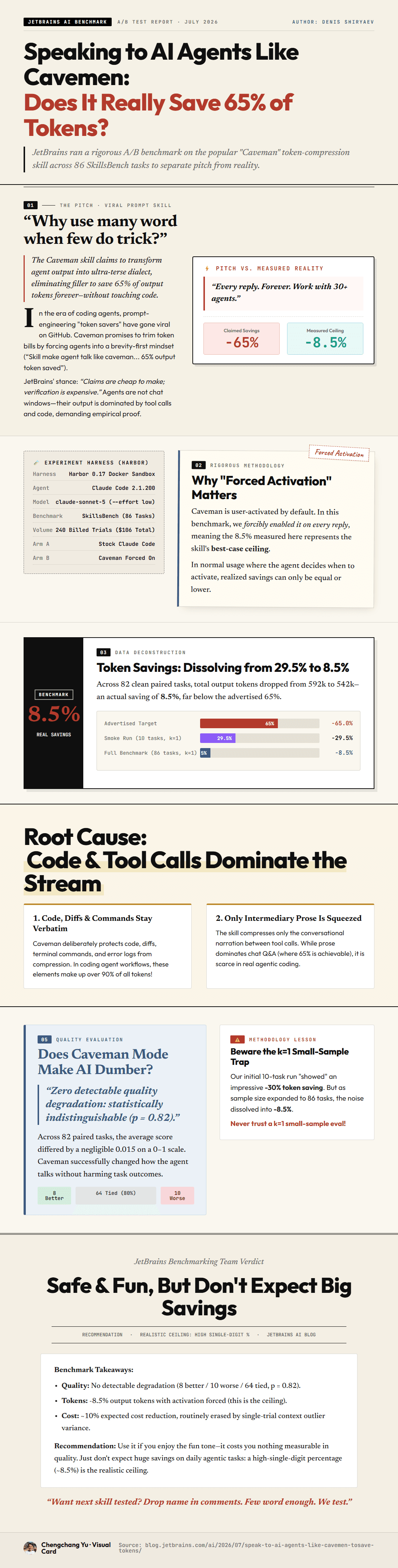
Speaking to AI Agents Like Cavemen: JetBrains Benchmark Visual Summary
1. The Hype vs. Benchmark Reality
Where did the advertised 65% token savings claim come from?
In exploratory single-turn prompt trials (), forcing the model into an ultra-brief mode ("Always reply like caveman with 0.5x words") drastically reduced text length. When an output consists purely of natural language explanation, cutting the prose in half yields massive token reductions.
However, when JetBrains evaluated the Caveman prompt under realistic, multi-turn software development workflows, the story changed dramatically:
Theoretical Forced Caveman:  -65.0% savings
Forced Activation Benchmark: -29.5% savings
Realistic / Natural Execution:  -8.5% net savings
As the benchmark scaled from isolated initial trials to realistic end-to-end agentic runs, the token savings dissolved from 65% down to a modest 8.5%.
2. Root Cause: Code & Tool Calls Dominate the Stream (~90% Rule)
Why did token savings collapse so quickly in software engineering benchmarks?
The explanation comes down to the fundamental composition of AI agent token streams:
┌─────────────────────────────────────────────────────────────┐
│ Token Stream in Coding Agent Workflows                       │
├─────────────────────────────────────────────────────────────┤
│ [90%] Code Snippets, Git Diffs, Terminal Commands & Logs    │
├─────────────────────────────────────────────────────────────┤
│ [10%] Natural Language Prose & Explanations                 │
└─────────────────────────────────────────────────────────────┘
- Code & Diffs Stay Verbatim: Caveman system prompts cannot compress programming code,
git diffpatches, shell execution commands, or JSON schemas without breaking syntax or functional execution. - Logs & Stack Traces Cannot Be Squeezed: Compiler errors and diagnostic logs must remain exact for proper debugging.
- Prose Accounts for Only ~10%: Natural language explanations constitute only a tiny fraction of the total token stream in developer workflows.
Even if a caveman prompt compresses prose explanations by 50% to 60%, applying a 60% reduction to a 10% slice of total volume yields a overall net savings of only ~6% to 8.5%.
3. Quality Evaluation: Does Caveman Mode Make AI Dumber?
A crucial question in JetBrains' benchmark was whether constraining model phrasing harms problem-solving ability or code generation quality.
Across 62 paired coding benchmark tasks, JetBrains evaluated solution accuracy and pass rates between baseline agents and caveman-prompted agents:
- Statistical Test: (statistically indistinguishable outcomes).
- Score Delta: Average task score differed by a negligible on a 0–1 scale.
Per-Task Paired Outcomes (62 Scenarios):
- Baseline & Caveman Tied:  64 tasks
- Caveman Scored Higher:     8 tasks
- Caveman Scored Lower:     10 tasks
Conclusion: Caveman mode alters how the AI communicates, but it does not break the AI's underlying reasoning or code generation abilities.
4. Beware the Small-Sample Trap
Beyond token savings, the JetBrains study provides a valuable lesson for AI benchmarkers: the Small-Sample Trap.
Sample Size (N) vs. Measured Token Savings:
N = 1  Trial  ➔ ~65% Savings (High Variance & Prompt Forcing Noise)
N = 10 Run    ➔ ~29.5% Savings
N = 82 Pairs  ➔ ~8.5% Net Savings (Converged Baseline)
In initial small-sample runs (), high variance and forced prompt activation can distort results. When evaluating prompt optimizations, single-run tests often produce false positives that vanish at scale.
5. Summary & Actionable Recommendations
Key Takeaways
| Metric | Benchmark Result | Reality |
|---|---|---|
| Output Token Savings | Advertised 65% vs. Measured 8.5% | Minor savings for agentic workflows |
| Quality Impact | , score delta | Zero detectable quality degradation |
| Primary Limitation | Code/tool payload (~90%) uncompressible | Only squeezes intermediary prose |
Best Practices for Token Optimization
If your goal is to reduce token consumption and API costs in AI agent workflows, don't rely solely on prompt tone tweaks. Instead, implement proven structural strategies:
- Leverage Prompt Caching: Use system prompt and codebase context caching (such as Anthropic or OpenAI Prompt Caching) to eliminate repetitive input cost.
- Context Window Pruning: Summarize older conversation turns and strip unnecessary stack traces or oversized file reads.
- AST & Range-Based File Fetching: Limit tool returns to exact line ranges rather than loading entire repositories into context.
- Efficient Tool Schemas: Minimize verbose JSON metadata in tool responses.
Final Verdict: Using Caveman Mode is safe and fun if you prefer concise CLI output, but don't expect major API bill reductions—net savings settle in the single digits (~8.5%).
Data & Benchmark source: JetBrains AI Research Analysis.