- Published on
Claude Skills :Don't Let the Buzzword Fool You - It's Actually Simple
- Authors

- Name
- Chengchang Yu
- @chengchangyu
You've definitely experienced this:
Yesterday you told Claude "our company reports should be formatted this way." Today, in a new conversation, you have to explain it all over again. Or you want AI to help process data, but first you spend 10 minutes explaining your data format, processing rules, and output requirements...
Every conversation feels like training an amnesiac intern.
Claude's recently released Skills feature fundamentally changes this experience.
What Exactly Are Skills?
In plain English: Skills are pre-packaged "capability bundles" you prepare in advance.
A Skill can contain:
- Prompts (telling AI how to work)
- Reference documents (like your company standards, data format specifications)
- Code scripts (for AI to call directly, without regenerating each time)
You package these into a folder and upload to Claude. From then on, Claude can directly invoke these "skills" in every conversation - no need to repeat yourself.
It judges on its own when to use which Skill.
You don't need complex prompts or patient re-teaching. Just say "help me process this PDF," and Claude sees the keyword and automatically invokes the "PDF Processing" Skill.
How Is This Different from Traditional Workflows?
Previously, when we built workflows on platforms, the process was fixed:
Step 1 → Step 2 → Step 3 → Output Result
The problem: One wrong step ruins everything.
For example, if you ask AI to write an article with workflow "outline → body → formatting":
- If the outline is bad, the article will be bad
- But the workflow has already started running
- You can't intervene mid-process to adjust
Skills Are Flexible Workflows
AI knows how to do each step (outlining, writing body, formatting... each is a Skill), but doesn't rigidly execute in sequence. It flexibly invokes needed Skills based on your actual requirements.
Example:
You've already written an article, just need a title and formatting.
- Traditional workflow: You have to re-run "outline → body → formatting" or manually skip previous steps
- Using Skills: You simply say "write me a title and format it," AI automatically invokes "Title Writing" and "Formatting" Skills, skipping unnecessary parts
It's like a real assistant who understands your needs, knows what tools are in the toolbox, and knows when to pull out which one.
The Most Brilliant Design: Modular, Reusable, Maintainable
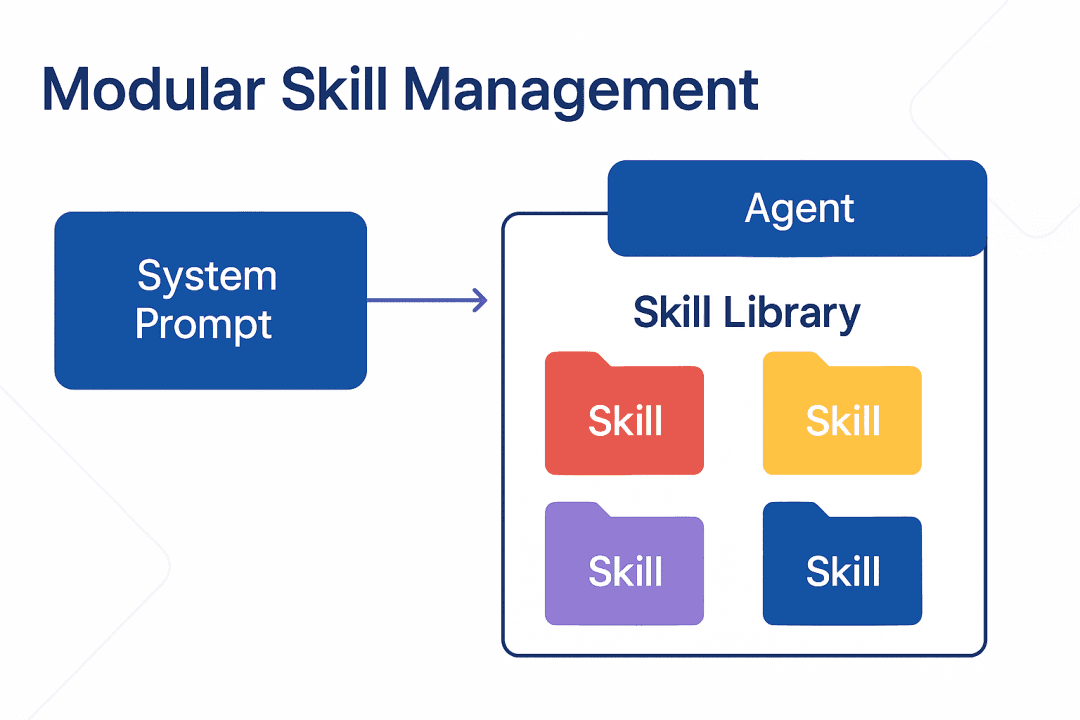
Modular Skill Management, Credit to: 安小强
This is where Skills truly shines - and it's not about AI innovation, it's about engineering excellence.
The Three-Layer Architecture
You might think: "I uploaded 10 Skills, each with thousands of words of documentation - won't Claude's context explode?"
Answer: No. Because Claude doesn't "memorize" all Skills - it "knows which Skills are available."
Layer 1: Metadata (Always in Claude's Mind)
- Skill name and when to use it
- Very small - each Skill is just dozens of words
- 10 Skills = only a few hundred words total
Layer 2: Main Instructions (Loaded When Needed)
- Only when Claude judges "this task needs this Skill" does it read the detailed instructions
Layer 3: Resources and Code (Read On-Demand)
- Detailed docs and code scripts are only read when actually needed
It's like your toolbox:
- You know what tools are in the box (metadata)
- Only when you need a screwdriver do you open the drawer (main instructions)
- Only in special cases do you check the manual (resource docs)
Why This Matters: Engineering Principles Applied to AI
The Skill structure follows battle-tested software engineering principles:
my-skill/
├── SKILL.md          # Core instructions (like README)
├── scripts/          # Executable code (like /src)
├── references/       # Documentation (like /docs)
└── assets/           # Resources (like /assets)
This means:
- ✅ Version control: Each Skill can be independently tracked in Git
- ✅ Testing: Test individual Skills without affecting others
- ✅ Team collaboration: Different team members can own different Skills
- ✅ Iteration: Update one Skill without breaking the entire system
- ✅ Reusability: Share Skills across projects and teams
So even with 50 Skills, daily conversations only consume minimal context, and your system remains maintainable.
The Core Insight: AI Agent's Future = 50% Model + 50% Engineering
Here's the truth that many people miss:
Everyone focuses on model capabilities - GPT-4, Claude 3.5, Gemini - but production AI systems fail or succeed based on engineering.
Think about it:
- A powerful model without proper tooling = An F1 engine in a shopping cart
- A decent model with excellent engineering = A reliable production system
What Anthropic Really Did
They didn't just release a concept. They released 20 production-tested Skill examples on GitHub (https://github.com/anthropics/skills).
This is the game-changer: They translated AI theory into engineering practice.
Skills proves that:
- Model intelligence gets you 50% there (understanding intent, generating responses)
- Engineering discipline gets you the other 50% (reliability, maintainability, scalability)
The Paradigm Shift
Before Skills:
- Throw everything into a massive System Prompt
- Hope the model figures it out
- When it breaks, rewrite the entire prompt
- No version control, no testing, no modularity
After Skills:
- Modular capabilities with clear boundaries
- Each Skill is independently testable
- System grows without becoming unmaintainable
- Engineering best practices applied to AI
When Should You Use Skills?
If you find yourself repeatedly doing these things, make them into Skills:
✅ Perfect Use Cases
1. Repeating the same background info every conversation
- "Our company report format is..."
2. Need AI to follow fixed standards
- Data cleaning processes, code review standards
3. Multi-step tasks, but don't want rigid workflows
- Content creation: topic selection → outline → body → optimization
- Each time needs slightly different steps
4. Team collaboration requiring unified standards
- Everyone uses the same Skills = consistent output quality and format
Real-World Example: Company Data Analytics Skill
internal-analytics-skill/
├── SKILL.md                    # "When user asks about data, use this"
├── scripts/
│   └── generate_report.py      # Auto-generate weekly reports
├── references/
│   └── db_schema.md            # Database structure docs
└── assets/
    └── report_template.docx    # Report template
Result: New team members just load this Skill - instantly know how to do data analysis. No retraining, no complex prompts.
When you need to update the report format? Just update this one Skill. All agents using it automatically get the update.
Skills vs MCP vs Traditional Workflows
Let's clarify the relationships:
| Concept | What It Solves | Analogy |
|---|---|---|
| MCP | How Agent talks to external tools | Communication protocol |
| Skills | How Agent thinks and acts | Employee training manual |
| Traditional Workflow | Fixed process execution | Assembly line |
Skills + MCP = Flexible, Powerful Agent
- MCP handles connection, Skills handle execution
- Skills can guide how to use MCP-compliant tools more effectively
The Bigger Picture
Before: Finished prompts were like "information packages" containing background, objectives, and rules.
Now: "Information packages" have been upgraded. Not only can you tell AI what/why/how in the prep phase, you can directly provide specific documents and code files for execution. More detailed, more powerful.
But more importantly: It's packaged using software engineering principles that have worked for decades.
One-Sentence Summary
Claude Skills isn't revolutionary AI - it's revolutionary engineering applied to AI.
The future of AI Agents isn't just about smarter models. It's about combining model intelligence with engineering discipline to build systems that actually work in production.
Conclusion
Don't let buzzwords intimidate you. Skills is simply: teach once, use forever - with proper engineering.
For teams building production AI systems, the lesson is clear:
- Stop chasing the latest model
- Start building proper engineering foundations
- Make your AI capabilities modular, reusable, and maintainable
The AI Agent's future: 50% model capability, 50% engineering excellence.
And Skills shows us exactly how to achieve that balance.
Related Resources:
- Claude Skills Official Repository: https://github.com/anthropics/skills
- Idea Credit from 安小强: https://www.zhihu.com/question/1962512846630941008/answer/1963073531265913943